
How to work out your food cost percentage (and what to do about it)
Food cost percentage is the single number that tells you whether a menu is working. Here is how to calculate it properly, what a healthy figure looks like, and the four things that quietly push it up.
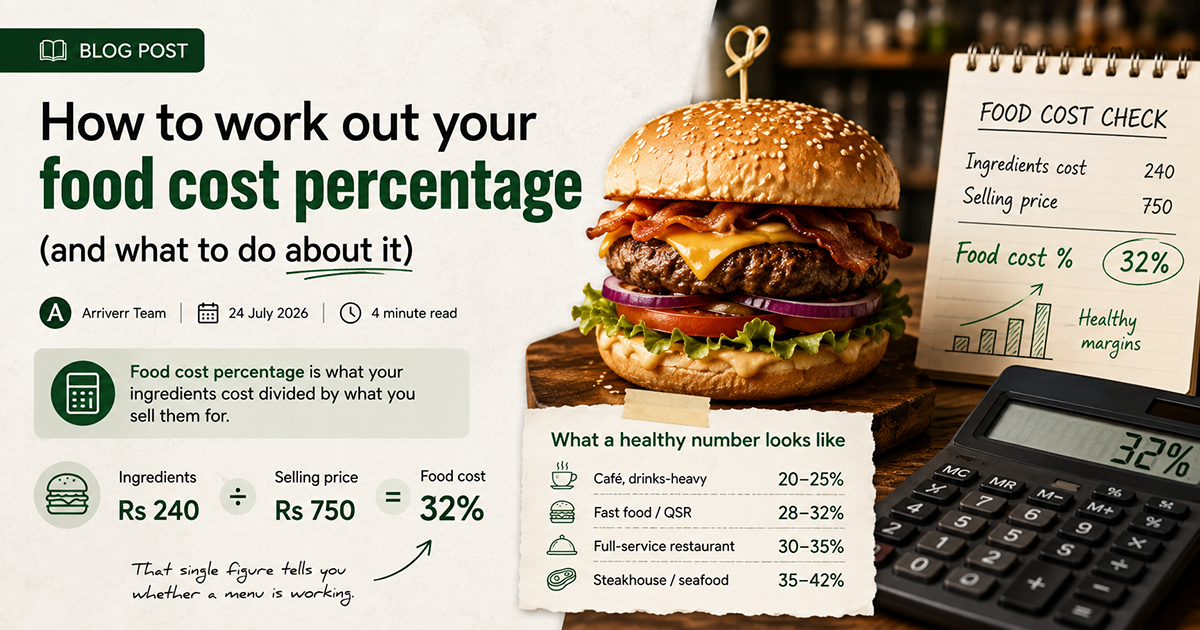
Food cost percentage is what your ingredients cost divided by what you sell them for. A burger with Rs 240 of ingredients selling at Rs 750 has a food cost of 32%. That single figure, tracked honestly, tells you more about whether a restaurant works than the day's takings do.
The two calculations, and why you need both
Per dish — the theoretical cost
Add up what the recipe actually uses: 150g of mince at Rs 1,100/kg is Rs 165, a bun at Rs 25, cheese at Rs 35, sauce and salad at Rs 15. That is Rs 240. Sold at Rs 750, the food cost is 32% and the gross margin is Rs 510.
This is the number that tells you whether the price is right.
Across the period — the actual cost
Take your opening stock value, add everything you purchased, subtract your closing stock. That is what you actually consumed. Divide by food sales for the same period.
This is the number that tells you whether the kitchen is running the way the recipes say.
The gap between them is the real finding
If your recipes say 31% and your stock count says 38%, seven percentage points of food left the building without being sold. On monthly sales of Rs 3,000,000 that is Rs 210,000 — every month.
That gap is over-portioning, waste, spoilage, staff meals nobody recorded, or theft. Which one it is matters, but knowing the gap exists comes first.
What a healthy number looks like
| Type | Typical food cost |
|---|---|
| Café, drinks-heavy | 20–25% |
| Fast food / QSR | 28–32% |
| Full-service restaurant | 30–35% |
| Steakhouse / seafood | 35–42% |
Do not chase somebody else's number. A steakhouse at 40% with a Rs 4,000 average bill makes far more per table than a café at 22% with a Rs 400 one.
The four things that quietly push it up
1 · Portions drift
The recipe says 150g. The cook who has been there three years uses "a good handful", which is 180g. That is 20% more mince on every burger, and nobody is doing anything wrong on purpose. Scales on the line fix it. So does costing the dish at the real portion rather than the intended one.
2 · Purchase prices move and menu prices do not
Cooking oil went up 30% and the menu did not. If your recipes are tied to live purchase costs, the margin on every affected dish moves the day the invoice is entered, and you can see it. If your costing lives in a spreadsheet somebody updated in March, you find out at the end of the year.
3 · Waste that never gets written down
A tray dropped, a batch overcooked, prepped mise that did not sell. Each is small, none is recorded, and together they are usually two to four points of food cost.
4 · Staff meals at menu price
Staff meals are a real cost, but they are an ingredient cost, not a lost sale. Recording them at menu price makes your food cost look better than it is and your revenue look bigger than it is. Record them at cost.
Doing this without a spreadsheet
All of the above is arithmetic, and arithmetic is what software is for. If each dish has a recipe attached, every sale deducts its ingredients from stock at cost automatically — the theoretical figure is live, the actual figure comes from your stock count, and the gap is visible without anyone doing sums at midnight.
That is what recipe costing in POS Beast does. But the method above works on paper too, and doing it on paper once is a better education than any report.
Start with ten dishes
Do not try to cost the whole menu this week. Take your ten best sellers — which are usually most of your volume — and cost those properly. You will find at least one dish selling well and making nothing.
Try it on your own restaurant
Everything described here is in the software. A 7-day trial opens immediately, with no card.